Thumbnail Sketches or a Full-Size First Pass?
Thumbnail sketches or a full-size first pass? Choose the right starting scale to settle composition early or work directly on the details that matter.
Should you begin with thumbnail sketches or work at full size? The choice is less about being a “planner” or a “plunger” than about which question your image needs answered first. A thumbnail makes it easy to compare broad arrangements; a full-size first pass lets you judge the marks, edges and small relationships that may carry the work.
Both approaches can lead to a strong image, and you can also move between them. The useful decision is where uncertainty sits: in the overall composition, or in how the image behaves at its intended scale. Start there, rather than treating thumbnails as a compulsory warm-up.
What can a thumbnail sketch tell you?
A thumbnail is a small, quick drawing that reduces an image to its main shapes and value groups. You might use a pencil, a brush pen, or grey markers on a scrap of paper. At that size, you can try several placements without committing to polished contours or surface detail.
This makes thumbnails especially useful for questions about hierarchy. Is the subject easy to notice? Does a large dark shape pull attention away from it? Is there enough open space around the focal point? A little drawing can reveal a lopsided arrangement before you spend time rendering it.
Keep the marks broad. Block in the largest light and dark areas, then use a simple shape for the subject. If you draw every button, leaf or eyelash, you have shifted from testing composition to making a small, hard-to-read finished picture.
Thumbnails suit a project with several plausible layouts: a poster with a title and portrait, a landscape with competing foreground shapes, or a page illustration that must leave room for text. They are also handy when your materials are costly, slow to prepare or difficult to revise. The aim is not to predict every detail; it is to find an arrangement worth exploring.
Use a thumbnail when the whole image still feels unsettled.
What does a full-size first pass reveal?
Working at final scale exposes problems that small studies can hide. A line that looks lively in a tiny sketch may become stiff when enlarged. A delicate gap between two shapes may disappear, while a quiet corner may feel far too empty once the image occupies a whole sheet.
Full-size work is often the better starting point when the surface itself matters. On watercolour paper, the way a wash spreads can shape the composition. With charcoal, soft edges and rubbed passages may be part of the image’s character. In ink, the width of a stroke can change how heavy a form feels. These qualities are difficult to judge from a little box on scrap paper.
It also suits work with a single clear arrangement and a detail-led purpose. If the main question is how a hand grips a cup, how a patterned fabric bends, or how a narrow highlight separates two forms, beginning at scale puts your attention where it is needed. You can make a light, open first pass rather than labouring every mark.
There is a trade-off. A large sheet gives you room to inspect small relationships, but it can make an uncertain composition feel more costly to change. If you tend to polish the first placement simply because it has already taken effort, set a limit: decide what the first pass is meant to answer before adding finish.
How do you choose between the two?
Ask what would be most annoying to discover late. If the answer is “the subject is in the wrong place” or “the dark mass swallows the focal point”, start with thumbnails. If it is “the texture does not work at this size” or “the line needs a different weight”, work on the final surface earlier.
You can also consider how reversible the medium is. A digital canvas lets you move and resize elements, so a rough full-size layout may be quick to adjust. A pen drawing on finished paper offers less room for repositioning; small compositions can help you settle placement first. Neither medium dictates one method, but the cost of revision should affect your choice.
Say you are making a portrait of a cyclist passing a row of shopfronts, and the crowded background makes the subject hard to place. You could draw three thumbnail boxes, reducing the rider, bicycle and buildings to simple shapes. If one version gives the rider a clear silhouette and leaves the shop signs as quieter blocks, the expected visible result is a composition that reads more clearly before you tackle facial features or lettering.
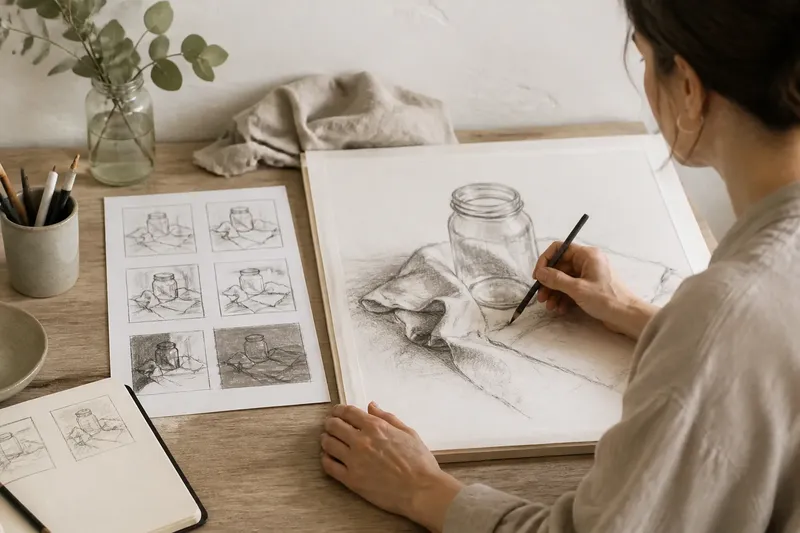
By contrast, imagine you are drawing a close view of a glass jar beside a folded cloth. The arrangement already feels settled, but you are unsure whether the glass edge and cloth folds can share the same space without becoming confusing. A full-size first pass lets you compare their actual line weights and edges; you can expect to see whether one needs to soften, break or simplify its marks.
For a mixed project, use both with separate jobs. A thumbnail can settle the placement of large forms; a small full-scale test on a spare piece can explore a difficult material effect. Keep the tests distinct, so the tiny layout does not pretend to resolve surface behaviour, and the material sample does not become an unplanned finished composition.
Which approach fits your working habits?
Thumbnail sketches often suit illustrators, designers and painters who enjoy comparing options before committing. They can also help if you tend to overwork details while the larger structure remains uncertain. The small format makes it natural to stop at the level of simple shapes.
A full-size first pass may suit artists who think through their hands, rely on a particular surface, or lose useful energy when asked to repeat an idea in miniature. It can be especially satisfying for a one-off drawing where the physical rhythm of making is part of the result. If you choose this route, keep the initial marks light or loose enough to leave room for changes.
Some people find that a thumbnail becomes a form of avoidance: they keep making alternatives instead of selecting one. Others discover that a “quick” full-size start becomes a polished commitment. Notice which delay you are more likely to fall into, then choose the format that makes a decision easier.
For a quick reset, finish a small study with one plain sentence: “This version works because…” If you cannot name a visible reason, keep comparing or change scale.
Which questions help you choose a drawing scale?
How small should a thumbnail sketch be?
Make it small enough to draw quickly, but large enough to distinguish the principal shapes. If important areas collapse into one dark patch, enlarge the box or simplify the image further.
Can you skip thumbnails and begin at final size?
Yes, especially when the composition is already clear or the medium needs to be judged at scale. Keep the first pass provisional so you can still adjust placement before adding detail.
Should a thumbnail include shading?
Use only enough value to check the main light-and-dark arrangement. A few broad grey or black shapes usually answer that question more clearly than detailed modelling.
When should you move from a thumbnail to a larger drawing?
Move on when one arrangement has a clear focal point and the major shapes sit well together. At the larger scale, test the details, edges and material behaviour that the thumbnail cannot show.
How can you keep either first pass useful?
Give the pass a narrow purpose. A thumbnail might test the direction of a figure and the space around it; a full-size drawing might test whether a pale contour remains visible against a textured ground. When you know what is being examined, you are less likely to decorate a study that has not answered its main question.
Compare at the scale the viewer will encounter. Stand back from a large drawing to check its main read, or view a digital image as a small on-screen preview if it will appear as a compact graphic. Then look close for the detail questions that matter. Switching distance helps prevent either broad composition or fine craft from taking over the whole decision.
Keep only the marks that help you decide. A thumbnail can be rough, and a full-size first pass can be incomplete; neither needs to look presentable. If you have to make a fresh version to keep the work moving, carry forward the one decision that matters most rather than copying every line.
For thumbnail sketches or a full-size first pass, choose the scale that makes your next uncertain decision visible. If the arrangement is the question, shrink it. If the material or detail is the question, meet it at final size. The best starting point is simply the one that lets you see what to do next.