The Reference Trap: Looking Without Copying
Learn how to use visual references without copying: sort what you notice, choose what fits your project and transform it into original material.
How do you use visual references without copying the thing you admire? Start by asking what you need from the image: a colour relationship, a surface quality, a mood, or a way that light falls. A reference becomes useful when you carry one observation into your own project, rather than borrowing the whole arrangement.
What are you trying to learn from the reference?
Before collecting images, name the uncertainty in your work. Perhaps a painted wooden box feels too clean, a collage needs a quieter colour, or a short story’s setting lacks texture. A clear question gives your looking somewhere to land.
Choose references that answer that question, not images that simply resemble the finished work you hope to make. If you are building a weathered surface, a close view of peeling paint might be more useful than a polished photograph of an entire room. The tighter subject gives you something specific to observe without dictating your composition.
Write a few plain notes beside each image: “dusty blue under warm grey”, “hard edge against soft shadow”, or “repeated marks, unevenly spaced”. Those phrases describe decisions you can make with your own materials. Avoid notes such as “make it like this picture”; they keep the reference in charge.
Which situation sounds most like yours?
Are you stuck on one visual detail?
Use a close reference for that detail alone. Look at the edge, grain, fold, reflection or mark you cannot yet picture, then describe its qualities in words before returning to your work.
Do you have a mood but no direction?
Gather references from different sources, such as a landscape photograph, a scrap of fabric and a stained paper wrapper. Compare their shared qualities, then choose a colour, texture or rhythm that can carry the mood without lifting one source’s whole look.
Does your work already resemble one image too closely?
Set that image aside and identify the borrowed features: perhaps the same crop, object placement and palette. Keep only the underlying question you were exploring, then change the subject, arrangement and material choices before continuing.
Are you working from a real object or place?
Observe directly where you can, and use photographs to revisit details you cannot keep in view. Record what changes as you move around the object or return at another moment; those observations belong to your encounter, not just to a single fixed view.
How can you turn looking into your own material?
Try a simple observation-to-transformation process. It is not a formula for every project; it is a way to separate what you noticed from the form you choose to make.
- Ask a focused question. Name the feature you need help seeing, such as how rust shifts from orange to dark brown.
- Observe without composing. Look for colour, texture, light, spacing or movement. Note qualities rather than tracing outlines or copying the full layout.
- Choose one useful quality. Select a single observation that serves your project. Leave the rest with the source.
- Change the conditions. Alter at least two things in your own work: the scale, viewpoint, subject, medium, palette or arrangement.
- Check what the reference is doing. Cover it or close the tab and look at your work. If your decisions still feel dependent on the image, return to your notes rather than copying from the screen.
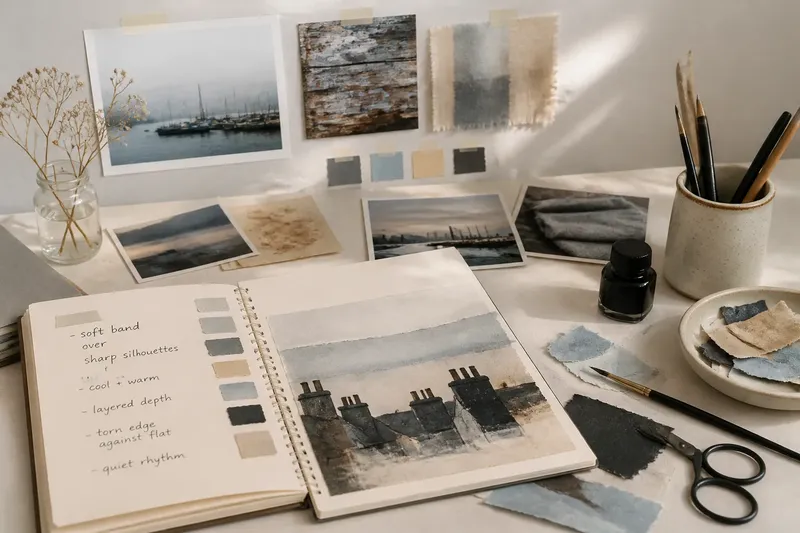
Say you are making a paper collage and notice the way a photograph of a harbour layers pale mist over dark boats. You note “soft band over sharp silhouettes”, then use torn tissue and ink to build that contrast around a row of rooftops instead. The expected visible result is a similar sense of depth, expressed through a different subject, material and arrangement.
What changes help a reference become a starting point?
Transformation is more than swapping colours. If you retain the source’s distinctive composition, subject and marks, a new palette may not make the result feel independent. Change the parts that give the reference its identity.
- Shift the viewpoint: work from above, below or closer in, rather than keeping the same framing.
- Change the material: translate glossy metal into graphite, fabric into cut paper, or a soft cloud into a dry-brush mark.
- Alter the scale: make a tiny detail dominant, or reduce a large form to a small accent.
- Rearrange the rhythm: change the spacing, direction or number of repeated forms.
- Combine separate observations: take a colour relationship from one source and a texture from another, then apply both to a different subject.
These changes are useful because they turn looking into decision-making. You are not trying to conceal where an image came from; you are finding out which qualities matter to your project and giving them a new job.
When should you stop looking and return to the work?
Close the reference when it has answered your original question, or when new images are only making you compare your unfinished work with polished outcomes. A growing folder can feel productive while postponing the uncertain decisions that belong to you.
Make a quick mark, colour patch, material sample or written description before searching again. That small response reveals what you understood and what remains unclear. If you need another reference, you can search for the missing quality rather than collecting more images on the same broad theme.
If a source’s composition or distinctive treatment remains recognisable in your work, pause and make a larger change. For work intended for public or commercial use, consider the source’s permission and the relevant rights; where the rules matter to your situation, seek qualified advice.
How can you use references without copying?
Use references to sharpen attention, not to supply a finished answer. Name the question, record what you actually see, select one quality and transform it through your own subject, material or arrangement. That is the useful boundary between looking and copying: the source prompts a decision, but the decision becomes yours.