The Useful Mess of a First Draft
A first draft makes a slippery idea visible. Use this simple writing routine to get thoughts down first, then shape them into a clear, purposeful piece.
You have a sentence in mind, but it keeps changing as you try to write it. A first draft gives that slippery idea somewhere to land. The useful mess of a first draft is not a lesser version of the finished piece; it is a way to move thoughts out of your head so you can see what they are doing.
That distinction matters. If you try to invent, judge and polish every sentence at once, each task interrupts the others. Separate them instead: make a rough version, step away from it, then revise with a reader’s needs in view. The routine below works for an essay, a personal project or a short piece of fiction, and can be adapted to suit your own pace.
What is a first draft meant to do?
A first draft records the current shape of an idea, including its gaps and awkward turns. It lets you notice which details are vivid, which questions are unresolved and where your attention keeps returning. None of that needs to arrive in the right order.
Think of drafting as making a working surface. A line of dialogue, a half-formed claim or a note about a scene can sit there together until you understand their relationship. The page can hold contradictions that your memory keeps trying to tidy away.
This does not mean writing carelessly or filling pages for the sake of it. It means choosing a temporary aim: get enough material down to make the next decision possible.
How do you prepare to draft?
Before you begin, make the task small enough to start and clear enough to recognise when you have material to work with. You do not need a detailed outline. A few practical choices can keep the first pass from turning into an endless warm-up.
- Name the piece’s subject. Write a plain working sentence such as “This is about why my neighbour’s garden gate sticks in winter.” It can be clumsy; its job is to point you towards the subject.
- Choose a reader. Imagine one person who might care about the piece, rather than an invisible crowd. This helps you notice what needs explaining later.
- Set a modest boundary. Decide what the piece will cover and what can wait. A small scene, one argument or one question is easier to draft than a whole life’s worth of material.
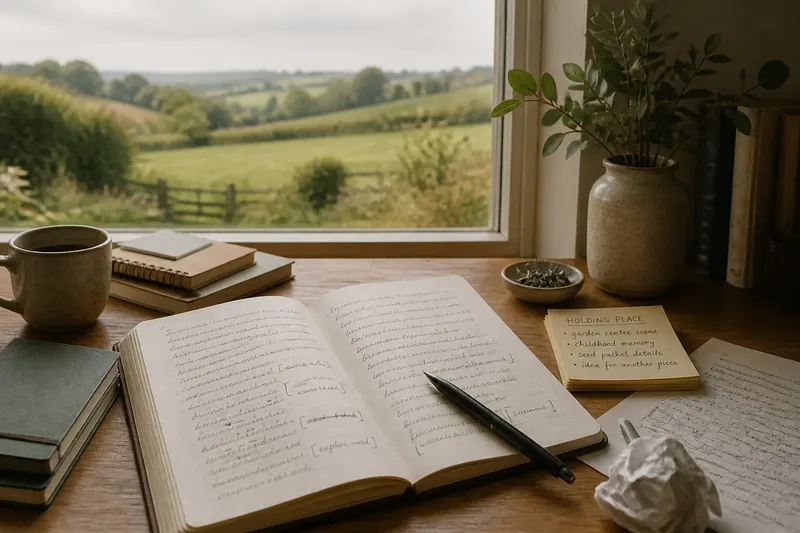
- Make a holding place for tangents. Keep a scrap of paper, a notes app or a separate document beside the draft. When an unrelated thought arrives, capture it there instead of following it.
- Choose a stopping signal. You might stop after reaching the scene’s turning point, answering a central question or leaving yourself a clear note about the next section. A natural stopping signal is more useful than waiting to feel finished.
Keep the working sentence visible. It is a compass, not a rule that forbids a better idea.
How do you get thoughts down without editing?
Start where the material feels easiest to reach. That may be the opening, but it could just as readily be a remembered conversation, a detail you can picture or the question that first caught your attention. Leave a bracketed note where a missing fact or transition belongs, such as “[check the bus route]” or “[explain why she leaves]”. A note is a useful stand-in; it keeps you moving without pretending the gap is solved.
Try drafting in short stretches. Write until you reach a pause, then add a few words about what you think comes next. If you stop because you cannot find the perfect phrase, use a rough substitute: “the room feels crowded”, “he gives in here”, or “[better word]”. Do not pause to tune every sentence.
Say you are writing about a friend’s abandoned allotment. You might begin with the nettles at the gate, jump back to the spring when the soil was turned, and end the stretch with a note to ask what happened to the seed packets. The expected observable result is a page containing a scene, a possible sequence and a question you can investigate—not a finished account.
When a stray idea threatens to take over, put it in your holding place. It is saved, not rejected. This simple move protects the draft’s current direction while leaving room for another piece later.
When should you stop the first pass?
Stop when you have enough material to see what the piece might become. That could mean a complete beginning-to-end attempt, or a set of connected sections with obvious gaps. You are looking for a workable object, not a polished one.
Before leaving the file, add a brief note to your future self: what is this piece trying to say, and what should you look at first next time? Keep it concrete. “Clarify why Mara changes her mind” is easier to act on than “make this better”.
Then close the document. A pause gives you a chance to return as a reader rather than continuing to tinker from inside the same thought.
How do you turn the rough draft into a shaped piece?
Begin the next session by reading the whole draft without changing anything. Notice where you are curious, confused or ready to move on. Mark those places with simple notes in the margin, or use a different text colour so you can distinguish comments from prose.
Now work from large decisions towards small ones. First, decide what the piece is really about. Then arrange the sections so each one helps develop that idea. Remove passages that belong elsewhere, fill the gaps that matter, and only then revise sentences for rhythm and clarity.
If you make line edits too early, you can become attached to a passage that no longer serves the piece. Shaping is not merely smoothing the rough edges; it is deciding what deserves to remain.
For an invented example, imagine the allotment draft contains a long description of a garden centre as well as the abandoned plot. On rereading, you see that the garden centre does not explain the friend’s change of heart. You move that passage to the holding document, add a clearer account of the decision, and expect the piece to feel more focused because its scenes now serve the same question.
Once the structure holds, read aloud. Listen for sentences that run on, repeated explanations and places where your voice sounds unlike you. Replace vague notes with accurate details, and check any factual claims you have left for later.
What if the page still feels empty?
Should you start at the beginning?
Only if the opening is the easiest place to enter. Draft the moment, question or claim you can reach, then add a bridge later if the piece needs one.
What if you keep rewriting the same sentence?
Leave a plain placeholder and move on to the next thought. You can return once the surrounding point is visible and you know what the sentence needs to do.
What should you do with a tangent?
Save it in your separate notes, with a few words about why it caught your attention. Later, decide whether it strengthens this piece or belongs in its own draft.
How do you know the draft is ready to shape?
You can identify its subject and point to enough material to support a possible structure, even if parts are missing. If you cannot yet say what connects the pieces, draft another section or write a note about the uncertainty.
How can you make this a repeatable habit?
Reuse the same sequence whenever a project feels tangled: set a small aim, draft without polishing, leave yourself a next-action note, pause, then revise from the whole towards the sentence. Keep the tools uncomplicated: one document for the draft, one place for saved tangents and a marker for unresolved questions.
The useful mess of a first draft is useful because it turns an invisible thought into something you can inspect, move and question. When you sit down for your next piece, begin with the part you can see most clearly and let the page hold the rest until you are ready to shape it.